My background is in empirical behavioral ecology. I specialize in taking complex, real-world biological observations—from collective predator evasion of extremophiles to invasive behaviorlal syndromes of non-native species—and designing the controlled experiments to understand the causes behind natural behaviors. As a researcher within several interdisciplinary collaborations, my role has consistently been to handle the biological side: designing the experimental setups, running the trials, ensuring biological validity, and analyzing the behavioral data. This hands-on data provided the baseline for the physicists, roboticists, and policy decision-makers I worked with.
Main research themes
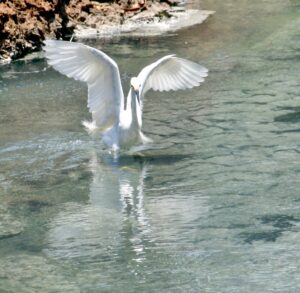
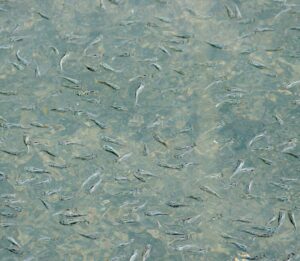
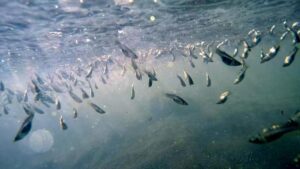
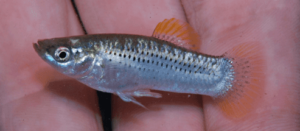
Collective Behavior and Predator-Prey Dynamics
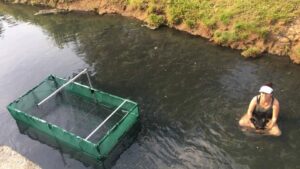
Core Research: Designed and ran experiments to test how fish collectives react to natural and simulated aerial predators, focusing on how “waves of agitation” form and spread.
Key Papers:
- Doran C & Bierbach D & Lukas J, Klamser P, Landgraf T, Klenz H, Habedank M, Arias Rodriguez L, Krause S, Romanczuk P, Krause J (2021) Fish waves as emergent collective antipredator behavior. Current Biology 32: 1–7.
- Gómez-Nava L, Lange RT, Klamser PP, Lukas J, Arias-Rodriguez L, Bierbach D, Krause J, Sprekeler H, Romanczuk P (2023) Fish shoals resemble a stochastic excitable system driven by environmental perturbations. Nature Physics 19: 663–669.
- Lukas J & Krause J, Träger AS, Piotrowski JM, Romanczuk P, Sprekeler H, Arias-Rodriguez L, Krause S, Schutz C, Bierbach D (2023) Multispecies collective waving behaviour in fish. Philosophical Transactions of the Royal Society B 378(1874): 20220069.
- Bierbach D & Lukas J, Gómez-Nava L, Francisco FA, Arias-Rodriguez L, Krause S, Pacher K, Sevinchan Y, Romanczuk P, Krause J (2025) Collective escape waves provide a generic defence against different avian predators. Royal Society Open Science 12(3): 241055.
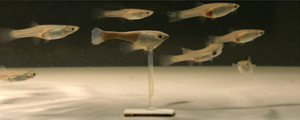
Social Interactions & Biomimetic Robotics
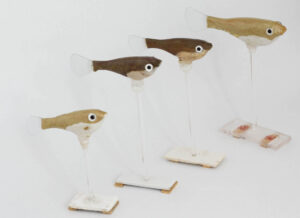
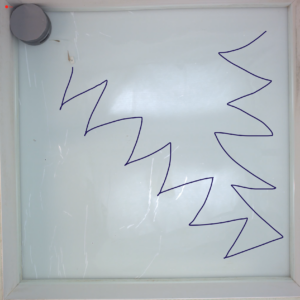
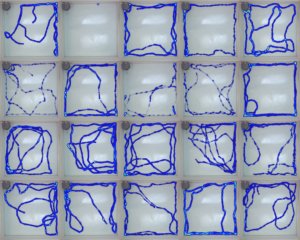
Core Research: Coordinated laboratory trials using a robotic fish as a standardized cue to test how real fish learn through social partners, choose and interact with leaders, and maintain group dynamics.
Key Papers:
- Bierbach D, Landgraf T, Romanczuk P, Lukas J, Nguyen H, Wolf M, Krause J (2018) Using a robotic fish to investigate individual differences in social responsiveness in the guppy. Royal Society Open Science 5(8): 181026.
- Bierbach D, Lukas J, Bergmann A, Elsner K, Höhne L, Weber C, Weimar N, Arias-Rodriguez L, Mönck HJ, Nguyen H, Romanczuk P, Landgraf T, Krause J (2018) Insights into the Social Behavior of Surface and Cave-Dwelling Fish (Poecilia mexicana) in Light and Darkness through the Use of a Biomimetic Robot. Frontiers in Robotics and AI 5: 3.
- Bierbach D, Mönck HJ, Lukas J, Habedank M, Romaczuk P, Landgraf T, Krause J (2020) Guppies Prefer to Follow Large (Robot) Leaders Irrespective of Own Size. Frontiers in Bioengineering and Biotechnology 8: 441.
- Bierbach D, Francisco F, Lukas J, Landgraf T, Maxeiner M, Romanczuk P, Musiolek L, Hafner VV, Krause J (2021) Biomimetic robots promote the 3Rs Principle in animal testing. Proceedings of the ALIFE 2021: The 2021 Conference on Artificial Life: Online publication (pp. 36).
- Bierbach D†, Gómez-Nava L†, Francisco FA, Lukas J, Musiolek L, Hafner VV, Landgraf T, Romanczuk P, Krause J (2022) Live fish learn to anticipate the movement of a fish-like robot. Bioinspiration & Biomimetics 17(6): 065007.


Biological Invasions & Risk Screening
Core Research: Studied the behavioral traits of invasive populations and their use of thermal refuges. I contributed this field knowledge to international teams to help translate and adapt risk-screening toolkits (AS-ISK) for regional use.
Key Papers:
- Piria M et al. (2017) Tackling invasive alien species in Europe II: threats and opportunities until 2020. Management of Biological Invasions 8(3): 273–286. http://dx.doi.org/10.3391/mbi.2017.8.3.02
- Lukas J, Kalinkat G, Kempkes M, Rose U, Bierbach D (2017) Feral guppies in Germany – a critical evaluation of a citizen science approach as biomonitoring tool. Bulletin of Fish Biology 17: 13–27.
- Copp GH et al. (2020) Speaking their language – Development of a multilingual decision-support tool for communicating invasive species risks to decision makers and stakeholders. Environmental Modelling & Software 135: 104900.
- Lukas J, Kalinkat G, Miesen FW, Landgraf T, Krause J, Bierbach D (2021) Consistent behavioural syndromes across seasons in an invasive freshwater fish. Frontiers in Ecology & Evolution 8: 583670.
- Vilizzi L et al. (2025) To be, or not to be, a non-native species in non-English languages: gauging terminological consensus amongst invasion biologists. Management Of Biological Invasions 16 (1): 15-31.
- Vilizzi L et al. (2026) Global framework for communication of biological invasion risks. Management of Biological Invasions 17 (1): 1-33.




Extremophile Ecology
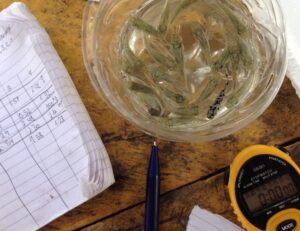
Core Research: Investigated how fish adapt their behavior and tolerate environmental stress in extreme habitats, such as toxic sulfur springs or cave systems with low-oxygen waters.
Key Papers:
- Bierbach D, Krause S, Romanczuk P, Lukas J, Arias-Rodriguez L, Krause J (2020) An interaction mechanism for the maintenance of fission–fusion dynamics under different individual densities. PeerJ 8: e8974.
- Lukas J, Auer F, Goldhammer T, Krause J, Romanczuk P, Klamser P, Arias Rodriguez L, Bierbach D (2021) Diurnal changes in hypoxia shape predator-prey interaction in a bird-fish system. Frontiers in Ecology & Evolution 9: 619193.
- Pacher K, Hernández-Román N, Juarez-Lopez A, Jiménez-Jiménez JE, Lukas J, Sevinchan Y, Krause J, Arias-Rodríguez L, Bierbach D (2024) Thermal tolerance in an extremophile fish from Mexico is not affected by environmental hypoxia. Biology Open13(2): bio060223.